
How EFT Tapping Helps Menopause Symptoms
EFT tapping for menopause symptoms is transforming how women manage hot flushes, brain fog, and anxiety at work. Unlike traditional menopause support that focuses on awareness and policy, EFT tapping provides immediate, evidence-based symptom relief.
If you’ve spent any time researching menopause support at work, you’ve probably seen the same recommendations repeated everywhere:
- Offer flexible working
- Provide temperature control
- Train managers to be sympathetic
- Share information about HRT
These are all SUPER important. But here’s what no one is telling you:
None of these things help a woman in the moment when a hot flush hits during a board presentation. None of these give her a tool she can use at her desk when brain fog makes it impossible to focus. None of these address the anxiety that wakes her at 3am worrying about work.
That’s where my work with EFT tapping comes in.
What Is EFT Tapping? And how does it help menopause?
EFT stands for Emotional Freedom Technique, though it’s more commonly known as tapping. It’s a self-applied stress reduction technique that combines elements of cognitive therapy with acupressure, tapping with your fingertips on specific meridian points on the face and body while thinking or talking about a particular issue or symptom.
It sounds weird. I know. The first time I explain it to HR teams, I see sceptical faces. But then I show them the research, and demonstrate it for them, and everything changes. (Read more about it here)
The Science: Why EFT Works for Menopause Symptoms
EFT is not new-age pseudoscience. It’s an evidence-based method that has been validated in over 100 clinical trials and is recognised as an effective treatment by organisations including Veterans Affairs in the US, the Canadian Psychotherapy Association, and the UK’s National Institute for Health and Care Excellence.
Here’s what makes EFT particularly effective for menopause symptoms:
1. EFT Targets the Root Cause: The Stress Response in the Brain
Most menopause symptoms, hot flushes, anxiety, brain fog, insomnia are directly linked to how declining oestrogen affects the brain’s stress regulation system. When oestrogen drops, the amygdala (your brain’s stress centre) becomes hyperreactive. This is why menopause symptoms are triggered or worsened by stress.
EFT works by sending calming signals to the amygdala while you’re actively thinking about the symptom or stressor. According to research led by Dr. Peta Stapleton, Associate Professor of Psychology at Bond University and one of the world’s leading EFT researchers, tapping deactivates the stress response in the brain and hippocampus (the memory centre), helping to regulate the autonomic nervous system.
🧠 BRAIN SCAN EVIDENCE: Dr. Stapleton’s groundbreaking fMRI research has produced the world’s first brain scans showing how EFT physically changes neural pathways. After just 4 weeks of tapping (8 hours total), participants showed significant reductions in brain activation in areas associated with stress, cravings, and emotional reactivity.
2. EFT Dramatically Reduces Cortisol (The Stress Hormone)
Dr. Stapleton’s 2020 randomised controlled trial, published in the Journal of Psychological Trauma, found that one hour of EFT tapping reduced cortisol levels by 43% — significantly more than psychoeducation (19% reduction) or rest (2% increase).
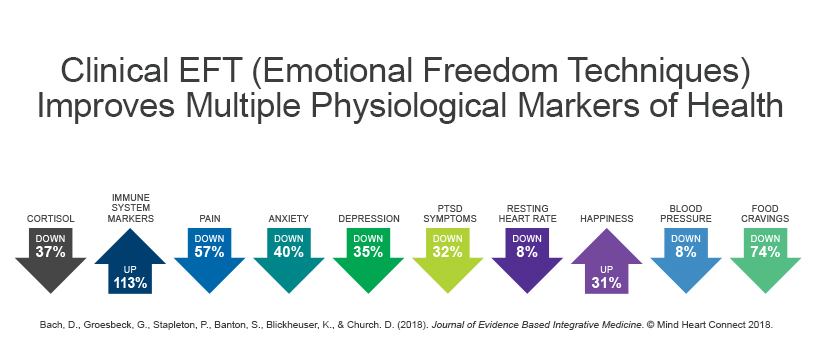
Why does this matter for menopause symptoms?
Because elevated cortisol worsens hot flushes, disrupts sleep, triggers anxiety, and impairs cognitive function. Lower cortisol = fewer and less severe menopause symptoms. This isn’t anecdotal, it’s measurable, biological change.
A 2012 study published in the Journal of Nervous and Mental Disease found EFT reduced cortisol by 24% after just 50 minutes – a significant improvement over supportive listening, which showed only a 14% reduction. Dr. Stapleton’s later research nearly doubled that effect.
3. EFT Reduces Anxiety, Depression, and Psychological Distress
Anxiety is one of the most commonly reported menopause symptoms, and it’s often the first symptom women experience, sometimes years before hot flushes or irregular periods begin. Even the most calm, organised and “unbothered” woman can start to feel worried about things like driving, losing things, anxious about upsetting people or feeling judged.
EFT has been extensively researched for anxiety and depression. Studies show:
- A meta-analysis of 14 studies found EFT produced substantial reductions in anxiety, depression, PTSD, phobias, and food cravings
- In a systematic review published in the Journal of Nervous and Mental Disease, EFT demonstrated anxiety reductions comparable to cognitive behavioural therapy (CBT) — often after just a single session
- Research on public speaking anxiety found EFT significantly reduced self-reported anxiety scores from clinical levels (10.22) to non-clinical levels (7.83)
- A large study of 5,000 patients over 5.5 years found 90% of those who received EFT reported reduced anxiety symptoms (compared to 63% in the CBT group), and improvements were sustained at one-year follow-up
Dr. Stapleton’s research consistently shows anxiety improvements of 58% or more after EFT interventions.
4. EFT Works Immediately And the Effects Last
This is the game-changer for workplace menopause support. Unlike HRT (which can take weeks to work), therapy appointments (which require waiting lists and don’t often help that much), or stress management courses (which take time to complete), EFT can be used in the moment when symptoms strike.
Research using The Tapping Solution app analysed 270,461 users across 380,034 tapping sessions and found:
- 29% average reduction in anxiety after a single guided tapping session
- 31% average reduction in stress after a single guided tapping session
And the benefits aren’t short-lived. Follow-up studies show that the improvements from EFT last over time — in some cases, up to two years after the intervention.
How EFT Helps Specific Menopause Symptoms
Menopause Symptom: Hot Flushes and Night Sweats
EFT practitioners report that tapping can stop a menopause hot flush when done at the first tingling of heat, and significantly reduces their intensity and frequency over time. While most research on EFT and vasomotor symptoms is still in the case study stage, the mechanism makes sense: hot flushes are triggered by stress and the autonomic nervous system, exactly what EFT regulates.
Research shows that anxiety and stress are major triggers for hot flushes. A 14-year follow-up study found a strong predictive association between somatic anxiety and menopause-related hot flushes. By addressing the underlying anxiety and stress response through EFT, many women experience fewer and less severe hot flushes.
Menopause Symptom: Brain Fog and Cognitive Function
Brain fog, difficulty concentrating, memory lapses, slow processing – is one of the most distressing menopause symptoms at work. It’s also directly linked to stress and cortisol. When cortisol is elevated, the prefrontal cortex (the thinking, problem-solving part of the brain) goes offline.
By rapidly reducing cortisol and calming the amygdala, EFT brings the prefrontal cortex back online, allowing women to think clearly again. Dr. Stapleton notes that when we’re stressed or anxious, it’s hard to think because the thinking part of the brain is literally low on blood supply. Tapping restores that function.
Menopause Symptom : Anxiety and Overwhelm
This is where EFT really shines. As Dr. Stapleton explains:
“The common denominator across all conditions that EFT treats, depression, anxiety, chronic pain, PTSD – is stress. Whether it’s depression, anxiety, or chronic pain, the autonomic nervous system is involved. EFT regulates that system.”
For menopausal women experiencing anxiety, panic attacks, or feeling constantly overwhelmed, EFT provides immediate relief and a long-term self-regulation tool.
Menopause Symptom: Sleep Disruption and Insomnia
A 2016 study found that physiological markers of insomnia and pain declined significantly after EFT tapping. This makes sense: if you’re lying awake at 3am with racing thoughts and anxiety, tapping calms your nervous system, lowers cortisol, and helps you return to sleep.
Why EFT Is Perfect for Workplace Menopause Support
Here’s why EFT is uniquely suited to the workplace context:
1. It’s Self-Directed
Once someone learns the basic tapping sequence (which takes about 10 minutes), they can use it independently. They don’t need to book appointments, wait for HR, or disclose their symptoms to anyone. It’s private, portable, and in their control.
2. It’s Immediate
You can use EFT at your desk, in a bathroom stall, during a break, or even discreetly during a meeting. It works in minutes — not weeks or months.
3. It’s Evidence-Based
This isn’t a wellness fad. EFT is validated by more than 100 clinical trials, multiple meta-analyses, systematic reviews, and fMRI brain scans. It meets the American Psychological Association’s criteria for an evidence-based practice.
4. It Addresses the Root Cause
EFT doesn’t just mask symptoms- it regulates the autonomic nervous system and reduces the biological stress response that drives menopause symptoms in the first place.
5. It’s Scalable
EFT can be taught in group workshops, online courses, or via apps. One trained facilitator (me) can teach dozens of employees the technique. This makes it cost-effective and accessible for organisations of any size.
What Dr. Peta Stapleton’s Research Means for Menopause Support
Dr. Stapleton is Australia’s leading researcher in Clinical EFT and has been recognised internationally for her work, including being named Psychologist of the Year in 2019 by the Australian Allied Health Awards and receiving the Harvey Baker Research Award for meticulous research and the greatest contribution to the field of Energy Psychology.
Her research portfolio includes:
- Over 100 published peer-reviewed studies on EFT
- World-first fMRI brain scans showing how EFT changes neural pathways
- Randomised controlled trials on cortisol reduction, anxiety, depression, PTSD, chronic pain, food cravings, and more
- Six meta-analyses showing large effect sizes for EFT in treating psychological conditions
- Evidence that EFT is equivalent to or more effective than cognitive behavioural therapy (CBT) for anxiety
Her book, The Science Behind Tapping: A Proven Stress Management Technique for the Mind and Body, consolidates findings from around the world and demonstrates that EFT has unusual speed, strong efficacy, and special strengths in facilitating targeted shifts in neural pathways.
One of the most striking findings from Dr. Stapleton’s work is her decade-long Harvard Medical School research showing that stimulating certain acupoints almost instantly decreases the activation of the stress response in the brain.
EFT in Practice: What It Looks Like in a Workplace Programme
When I work with organisations like Equal Experts, ANS, and Bureau Veritas, here’s how we integrate EFT into menopause support:
Workshop Training (2 Hours)
Employees learn:
- The neuroscience of menopause symptoms and why EFT works
- The basic tapping sequence and acupressure points
- How to use EFT for specific symptoms: hot flushes, brain fog, anxiety, sleep disruption
- Real-time practice with guided tapping rounds
Post-Workshop Resources
- Video guides for ongoing practice
- Downloadable scripts for common menopause symptoms
- Access to EFT apps for guided sessions
Follow-Up Support
- Optional drop-in Q&A sessions
- One-to-one sessions for employees dealing with complex or severe symptoms
The feedback is consistent: employees are initially sceptical, then surprised at how quickly it works, then grateful to have a tool they can use whenever they need it.
The Bottom Line: Why Every Menopause Programme Needs EFT
Most workplace menopause programmes focus on awareness and policy. And those things matter. But they don’t help the woman sitting at her desk right now, feeling her face flush red, her heart racing, her thoughts scattering.
EFT fills that gap. It’s the practical, evidence-based tool that turns menopause support from a policy on paper into real relief in the moment.
With over 100 clinical trials, fMRI brain scans, and demonstrated reductions in cortisol, anxiety, and stress, EFT tapping isn’t a wellness trend, it’s a validated intervention that addresses the root cause of menopause symptoms.
And perhaps most importantly: it gives employees back control. Instead of feeling helpless in the face of unpredictable symptoms, they have a technique they can use anytime, anywhere, to regulate their nervous system and manage their symptoms.
That’s not just compliance. That’s genuine care.
📥 READY TO BRING EFT TO YOUR WORKPLACE? Our Menopause Support Starter Kit includes compliance essentials (policy, manager training, risk assessments) PLUS a 2-hour EFT tapping workshop that gives employees real symptom relief. Visit louisahussey.com/menopauseatwork or book a call to discuss your needs.
References & Further Reading
1. Stapleton, P., Crighton, G., Sabot, D., & O’Neill, H. M. (2020). Reexamining the effect of Emotional Freedom Techniques on stress biochemistry: A randomized controlled trial. Psychological Trauma: Theory, Research, Practice, and Policy, 12(8), 869-877.
2. Church, D., Yount, G., & Brooks, A. J. (2012). The effect of Emotional Freedom Techniques on stress biochemistry: A randomized controlled trial. Journal of Nervous and Mental Disease, 200(10), 891-896.
3. Stapleton, P., Buchan, C., Mitchell, I., McGrath, Y., Gorton, P., & Carter, B. (2019). An initial investigation of neural changes in overweight adults with food cravings after Emotional Freedom Techniques. OBM Integrative and Complementary Medicine, 4(1).
4. Church, D., Stapleton, P., Vasudevan, A., & O’Keefe, T. (2022). Clinical EFT as an evidence-based practice for the treatment of psychological and physiological conditions: A systematic review. Frontiers in Psychology, 13, 951451.
5. Clond, M. (2016). Emotional Freedom Techniques for anxiety: A systematic review with meta-analysis. Journal of Nervous and Mental Disease, 204(5), 388-395.
6. Stapleton, P. (2019). The Science Behind Tapping: A Proven Stress Management Technique for the Mind and Body. Hay House UK.
7. Nelms, J. A., & Castel, L. (2016). A systematic review and meta-analysis of randomized and nonrandomized trials of Clinical Emotional Freedom Techniques (EFT) for the treatment of depression. Explore, 12(6), 416-426.
8. Athanasiadis, L., & Goulis, D. G. (2019). Starting and stopping menopausal hormone therapy and antidepressants for hot flushes: A case-based approach. Maturitas, 130, 52-56.
9. Hariri, S. (2025). Managing Menopause Anxiety. Hampstead Psychology. Available at: https://www.hampsteadpsychology.com
10. The Tapping Solution App Study (2019). Analysis of 270,461 users across 380,034 tapping sessions. Available at: https://www.thetappingsolution.com/research
11. Stapleton, P. (2021). Feeling stressed? It’s ‘a bit weird’, but tapping helps – and it’s easy to learn. The Conversation. Available at: https://theconversation.com
12. Bond University (2023). Dr Peta Stapleton named psychologist of the year. Available at: https://bond.edu.au/news13. Evidence Based EFT (2025). EFT Science. Available at: https://www.evidencebasedeft.com/EFTscience
Leave a Reply

Fed up of being in pain?
Book your 1 to 1 session by hitting the button below...
BOOK HERE
Got questions? Drop me a message via the contact form below and we can see if we might be a good fit.